Instrument Scientist (PhD)
Vacature
- Leiden
- PhD
- Fulltime
8285,-



8285,-
Are you an experimental physicist with a proven track record in the development and characterization of superconducting devices, including expertise in low-temperature photon detectors? Do you have hands-on experience with cutting-edge ultra-cryogenic facilities?
SRON develops ultra-cryogenic instruments where the sky is no limit.

You have the chance to be part of a team of instrument scientists, engineers and astronomers with a prominent track record in the development of X-ray detector technology and space instruments.
SRON, as one of the leading institutes in the field, has contributed to the X-ray instruments for ESA (XMM-Newton), NASA (Chandra) and Jaxa (Hitomi). The NewAthena X-ray mission has been selected by ESA as the next Large mission. The telescope will have two main instruments on board: a Wide Field Imager and an X-ray spectroscopy instrument X-IFU (X-ray Integral Field Unit). The launch of NewAthena is planned for 2037.
SRON is responsible for developing the cryogenic Focal Plane Assembly (FPA) of the X-IFU instrument, which serves as the optical heart of the device. The Flight Model is expected to be delivered around 2035, and several prototype models will be developed to test the applied technologies.
The first FPA Demonstration Model, utilizing NASA detectors and NIST TDM readout, has been successfully assembled in SRON’s cleanroom and is now integrated into a cryogenic test setup that cools the detector stage to below 50 milli-Kelvin.
Concurrently, the SRON team is working on the X-IFU backup technology for the detector array and the read-out chain, which is based on a cutting-edge superconducting Transition Edge Sensor (TES) detector array operating at milli-Kelvin temperatures. The pixels are read out using Frequency Division Multiplexing (FDM). The readout chain operates at MHz frequencies and includes superconducting high-Q LC-filter chips, Superconducting QUantum Interference Devices (SQUIDs), and room temperature digital and analog electronics.
Besides NewAthena, SRON has a leading role in developing (microwave) superconducting detectors for future visible, near- and far-infrared radiation, and CMB space mission such as PRIMA, LiteBIRD and HWO.
Apply now
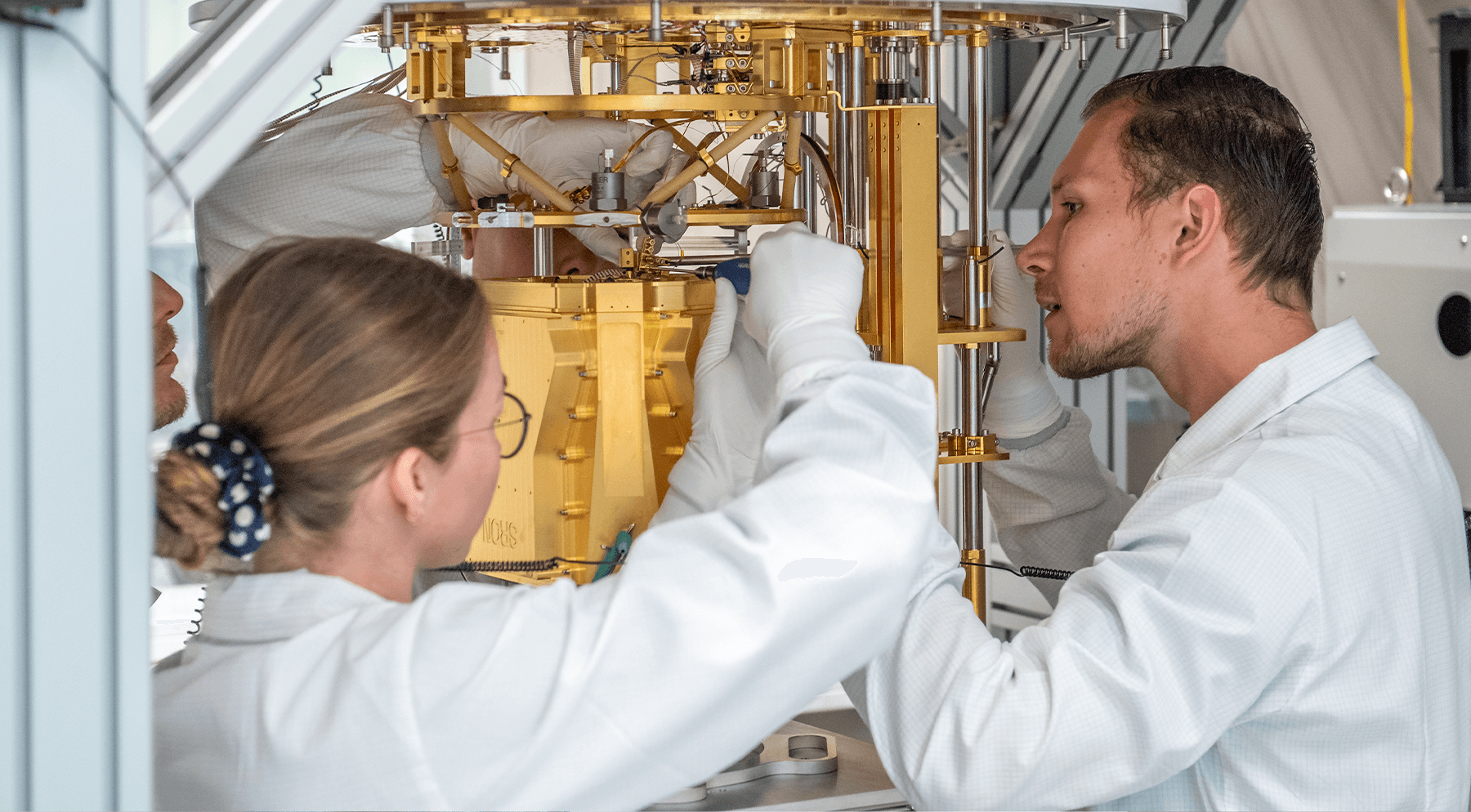
As a key member of a team comprising instrument scientists and engineers, you will take a leading role in the program aimed at advancing the technology readiness level of the SRON X-ray microcalorimeter array and its frequency domain multiplexing readout. Additionally, you will participate in the on-going extensive testing campaign with the XIFU Focal Plane Assembly.
Competences
Employment of this full-time position as an Instrument Scientist at SRON-Leiden is by NWO-I (The Netherlands Organization for Scientific Research Institutes) and will be for a period of two years with a possible extension for a longer period. The collective labor agreement for research institutions applies. Salary will depend on education and experience but will not exceed €8.285,-gross per month (salary level 1-1-2026). The position is based in Leiden, The Netherlands.
NWO-I has good secondary employment conditions such as:
An end-of-year bonus of 8.33% of the gross yearly salary
A holiday allowance of 8% of the gross yearly salary
42 days of vacation leave a year on a full-time basis
An excellent pension scheme
Options for (additional) personal development
Excellent facilities for parental leave
Ample training opportunities
Possibility of flexible working hours
SRON's mission is to achieve breakthroughs in international scientific research from space. To this end, SRON develops cutting-edge technology and advanced space instruments. SRON promotes societal applications of space technology. We have a strong international reputation as 'excellent in space research'. The quality and societal relevance of our science is considered ‘world-leading’.
SRON is the Space Research Organisation Netherlands. Based at locations in Leiden and Groningen, SRON combines fundamental scientific research, technology innovation, and instrumentation development to enable breakthroughs in astrophysics, exoplanet research, and earth atmospheric research from space. In partnership with leading international partners and space agencies such as ESA, NASA and JAXA, SRON provides scientific and technological contributions to international space missions as well as expertise and support to the Dutch and international scientific communities.
SRON is the national base for the Netherlands participation in the ESA science program. On the national level, it works in close collaboration with the Dutch universities, other NWO institutes, and governmental agencies to pursue a cohesive agenda for space-based research.
At SRON we believe that a workforce diverse in gender, age, and cultural background is key to performing excellent research. We therefore strongly encourage qualified applicants of all ages, sexual orientations, gender expressions, members of minorities, persons with disabilities, and potential dual-academic-career hires to apply.
Online screening may be part of the selection procedure.
Recruitment consultants, please put down the phone. We’ll do the recruitment ourselves so unsolicited acquisition to this vacancy is not appreciated.